
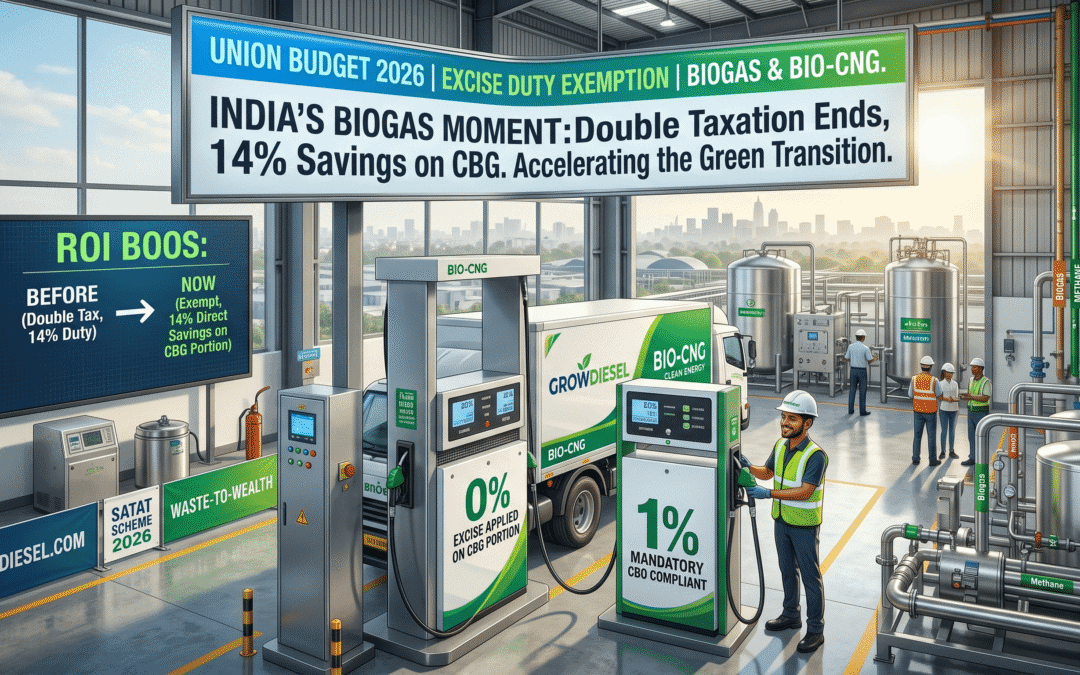
The Indian renewable energy landscape just crossed its most critical milestone. As of April 2026, the Compressed Biogas Obligation (CBO) has officially shifted from a voluntary policy into an ironclad legal mandate.
For green entrepreneurs, commercial developers, and agricultural investors, this policy shift has sparked a full-scale Bio-CNG Gold Rush.
Market risk has effectively dropped to zero.
1. The 2026 Bio-CNG Trading Safeguard: A Mandated Market
During high-interest-rate phases, traditional infrastructure projects often slow down due to extreme debt pressure.
If you are evaluating capital placement this year, the structural safety net has never been tighter:
| Macro Variable | The 2026 Bio-CNG Safeguard | Impact on Trading ROI |
| Market Risk | The 1% CBO forces gas distributors to buy local CBG. | Guaranteed Offtake: Every kilogram you produce has a locked-in legal buyer. |
| Tax Margins | Complete Central Excise Duty exemptions on the CBG portion. | 14% Margin Boost: Plant operators keep maximum cash flow natively within the business. |
| Capital Subsidies | Active Ministry of New and Renewable Energy (MNRE) assistance. | ₹4 Crore to ₹10 Crore in upfront capital subsidies to compress payback timelines. |
2. Purity Strategy: Meeting IS 16087:2016 Standards
You cannot trade raw biogas. Raw gas emerging from anaerobic digestion typically sits at a low 55% to 60% methane (
To legally trade and feed gas into an OMC grid, your plant must upgrade raw gas to meet the stringent IS 16087:2016 quality standards, requiring an exceptional greater than 96% methane purity standard.
Yesterday’s traditional water-scrubbing methods are rapidly dying out due to high operational costs (OpEx) and poor scalability.
Modern commercial trading relies on advanced technological stacks:
-
Vacuum Swing Adsorption (VSA): Systems that handle high flow volumes with minimal energy drag.
-
Multi-Stage Polymer Membranes: Physical separation units that isolate methane molecules cleanly.
At Growdiesel, our proprietary Regwell™ Industrial-Grade Bio-CNG Technology paired with Meth-ChemX™ purification systems eliminates this technical barrier.
| Macro Variable | The Bio-CNG Safeguard |
| Market Risk | Zero. The freshly enforced 1% Compressed Biogas Obligation (CBO) legally forces City Gas Distribution (CGD) companies to blend bio-CNG, scaling aggressively to 5% by 2029. Offtake is fully guaranteed by law. |
| Tax Margins | Complete Central Excise Duty exemptions mean plant operators keep maximum cash flow natively within the business. |
| Subsidies | Active MNRE central financial assistance schemes provide between ₹4 Crore to ₹10 Crore in capital subsidies, rapidly shortening break-even timelines. |
3. The Multi-Stream Revenue Trading Model
In 2026, the most profitable Bio-CNG operations do not view themselves as simple waste management setups—they operate as advanced, localized bio-refineries.
A. Commercial Gas Sales
With commercial fossil fuel and imported LNG prices fluctuating wildly due to geopolitical shifts, domestic Bio-CNG prices hold firm and stable at roughly ₹46 to ₹55 per kg, offering long-term revenue predictability for your plant.
B. The Organic Manure (FOM) Premium
Methane isn’t your only liquid asset. The byproduct of your digester—Fermented Organic Manure (FOM)—is seeing a massive surge in value as the agricultural sector transitions toward soil-restoring practices.
C. Liquid Carbon Assets
The Indian Carbon Market (ICM) has fully matured.
4. Ditching Spreadsheets for Bank-Grade Data
Operating a multi-feedstock plant (mixing cow dung, sugarcane press mud, napier grass, and food waste) means variables change daily.
To bridge the gap between technical metrics and financial success, Growdiesel projects are paired directly with our specialized digital intelligence partner: BiogasFlux.com.
[Raw Multi-Feedstock Input]
           │
           ▼
[BiogasFlux.com Digital Intelligence Suite] ──► (Simulates 10-Year IRR & 2026 Subsidy Caps)
           │
           ▼
[Growdiesel Regwell™ & Meth-ChemX™ Infrastructure] ──► (Produces 98%+ Pure Bio-CNG)
[Raw Multi-Feedstock Input]
│
▼
[BiogasFlux.com Digital Intelligence Suite] ──► (Simulates 10-Year IRR & 2026 Subsidy Caps)
│
▼
[Growdiesel Regwell™ & Meth-ChemX™ Infrastructure] ──► (Produces 98%+ Pure Bio-CNG)
BiogasFlux acts as an advanced predictive analytics engine tailored exactly to the current tax logic and subsidy structures.
The Verdict: Act While the Trading Window is Wide Open
India’s roaring GDP growth means local energy demand is skyrocketing.
Don’t let your project sit on a generic spreadsheet. Use our digital modeling suite at BiogasFlux.com to run a precise technical ROI simulation for your local feedstock volume, or connect directly with the Growdiesel Advisory Team today to advance your clean energy asset from a blueprint to high-yield commercial execution.