
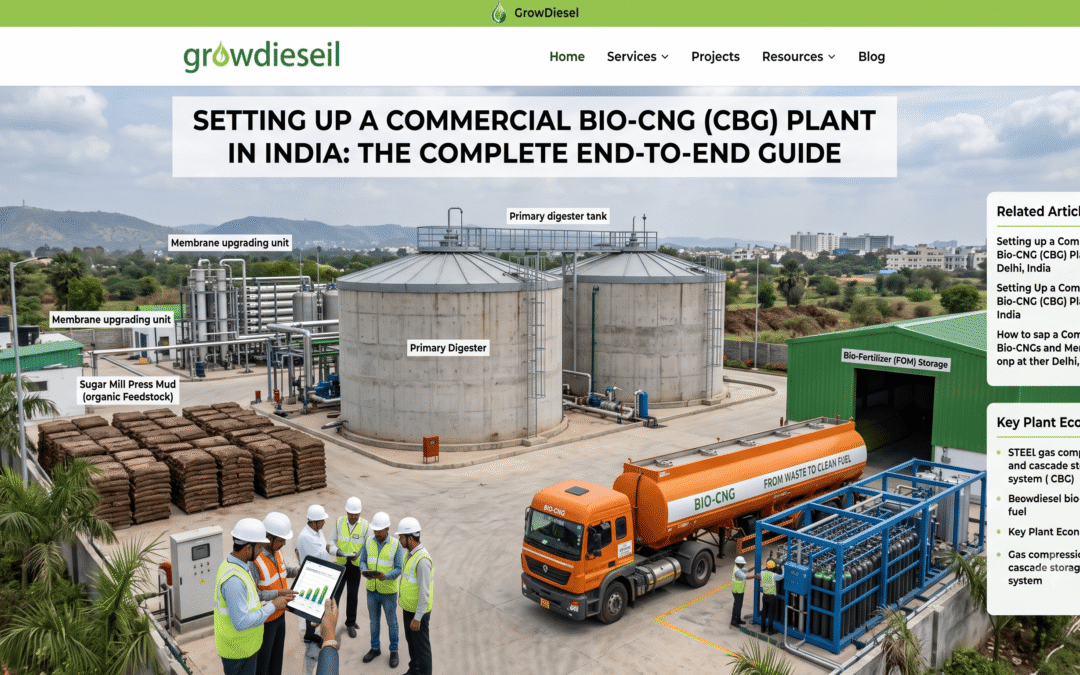
India’s transition to clean energy has turned industrial, municipal, and agricultural waste into one of the most profitable business opportunities of the decade.
Whether you are an agri-entrepreneur, an industrial facility owner, or an urban developer, setting up a CBG plant requires a clear understanding of feedstock selection, conversion technology, government subsidies, and commercial distribution.
1. What is Bio-CNG / CBG?
Bio-CNG is purified biogas produced via the anaerobic digestion of organic matter.
Through advanced scrubbing and upgrading, the methane concentration is boosted to over 90–96% (complying with IS 16087:2016 standards), making it a direct green substitute for fossil CNG in vehicular and commercial heating applications.
2. Choosing the Right Feedstock & Yield Potential
Feedstock availability and logistics dictate over 60% of a plant’s operational viability.
| Feedstock Type | Source / Sector | Average CBG Yield (per Ton) | Key Byproduct |
| Press Mud | Sugar Mills | 50 – 60 kg | High-grade Solid Fermented Organic Manure (FOM) |
| Paddy Straw / Agri-Residue | Farms & Aggregators | 45 – 55 kg | Bio-char / Bio-fertilizer |
| Cattle Dung | Dairies & Gaushalas | 15 – 25 kg | Liquid Bio-fertilizer (LFOM) |
| Segregated MSW (OFMSW) | Municipal Corporations | 30 – 45 kg | Enriched Soil Conditioner |
| Napier Grass / Energy Crops | Contract Farming | 40 – 50 kg | Organic Compost |
3. The End-to-End Plant Setup Workflow
[Feedstock Sourcing & Pre-Treatment]
                │
                ▼
   [Anaerobic Digestion / CSTR]
                │
                ▼
[Raw Biogas (55-65% CH4)]  ──► [Slurry Processing -> Solid & Liquid Bio-Fertilizer (FOM/LFOM)]
                │
                ▼
   [H2S & Moisture Removal]
                │
                ▼
[Membrane / PSA Gas Upgrading (>90% CH4)]
                │
                ▼
[Multi-Stage Compression (200-250 Bar)]
                │
                ▼
[Cascades / Direct Pipeline Injection]
Stage 1: Feedstock Pre-Treatment & Feeding
Different feedstocks require different handling. Agri-residues undergo shredding and enzymatic/hydrothermal pre-treatment to break down lignocellulosic bonds, while press mud and wet organic waste are homogenized into an optimal slurry.
Stage 2: Anaerobic Digestion (Methanogenesis)
The prepared slurry enters primary Continuous Stirred Tank Reactors (CSTR) or high-rate digesters. Mesophilic bacteria digest the organic compounds under controlled temperature ($37^\circ\text{C}$ to $40^\circ\text{C}$) and pH levels to generate raw biogas.
Stage 3: Gas Cleaning & Upgrading
-
Desulfurization: Biological or dry media scrubbers eliminate $H_2S$ to prevent equipment corrosion.
-
Moisture & Particle Filtration: Chilling units and particulate filters strip water vapor.
-
$CO_2$ Separation: Membrane separation or Pressure Swing Adsorption (PSA) isolates pure methane, compressing the gas to commercial Bio-CNG grade.
Stage 4: Compression & Distribution
The purified CBG is compressed to 200–250 bar into mobile cylinder cascades for retail dispensing stations or injected directly into City Gas Distribution (CGD) networks via dedicated blending pipelines.
4. Government Incentives & Offtake Policy (SATAT Framework)
The Indian government supports CBG projects through policy frameworks designed to de-risk capital investment:
-
SATAT Scheme (Sustainable Alternative Towards Affordable Transportation): Oil Marketing Companies (IOCL, HPCL, BPCL, GAIL) offer long-term Commercial Offtake Agreements with guaranteed baseline pricing for CBG.
-
Capital Subsidies (MNRE): Central Financial Assistance (CFA) provides grants up to ₹4 Crore to ₹10 Crore depending on daily processing capacity.
-
Priority Sector Lending (PSL): Commercial banks extend targeted financing terms for renewable energy and CBG plant setups.
-
Co-Product Monetization (FOM/LFOM): Fertilizer marketing companies and the Market Development Assistance (MDA) scheme provide ₹1,500/MT subsidies for selling organic fermented manure produced during digestion.
5. Key Plant Economics (Sample 5 TPD Project)
Estimated Project Metrics (Indicative for a 5-Ton/Day CBG Plant)
─────────────────────────────────────────────────────────────────
• Raw Feedstock Required    : 100 - 120 Tons/Day (e.g., Press Mud / Agri-waste)
• Daily CBG Production      : 5,000 kg (5 TPD)
• Daily Bio-Fertilizer (FOM): ~25 - 30 Tons/Day
• Estimated Capex           : ₹25 - 35 Crore (Plant, Machinery & Infrastructure)
• Revenue Streams           : 1. CBG Sales to OMC / Industrial Users
                              2. FOM/LFOM Sales to Agro Markets & Co-ops
                              3. Carbon Credits (VCS/Gold Standard)
• Estimated Payback Period  : 3.5 to 5 Years
Next Steps: Partnering with GrowDiesel
From detailed project reports (DPR) and feedstock analysis to turnkey plant design, EPC execution, and O&M management, GrowDiesel provides end-to-end technical support to build high-efficiency waste-to-energy assets.