
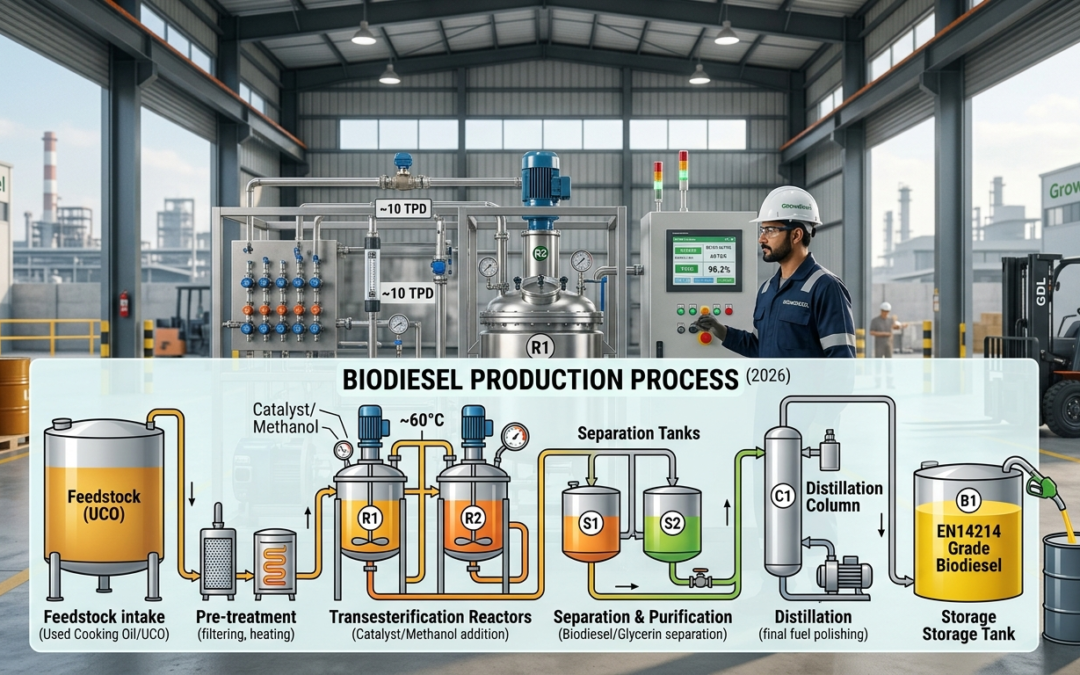
The landscape for renewable energy has shifted. In 2026, setting up a biodiesel plant is no longer just about environmental responsibility—it is a high-yield industrial investment driven by strict government mandates and a revolutionized feedstock supply chain.
Whether you are an entrepreneur looking into localized production or a corporation planning a large-scale refinery, this guide breaks down the essential technical and financial logic for a successful setup.
1. The 2026 Market Catalyst: The RUCO Factor
The primary challenge of biodiesel has historically been feedstock consistency. However, the Repurpose Used Cooking Oil (RUCO) initiative has matured. In 2026, the ecosystem for collecting UCO from the food industry is fully digitised, providing a steady, lower-cost raw material stream for biodiesel producers.
Investing in a plant today means tapping into a circular economy where “waste” is a guaranteed commodity. Plants designed with multi-feedstock flexibility—capable of processing UCO, acid oils, and non-edible vegetable oils—are seeing the highest profit margins.
2. Engineering the Process: Beyond Simple Mixing
A modern biodiesel plant is an orchestrator of complex chemical engineering. To achieve EN14214 international standards, the machinery must go beyond basic transesterification.
The Three Pillars of High-Yield Machinery:
-
Precision Pre-treatment: 2026 technology focuses heavily on reducing Free Fatty Acids (FFA). Efficient pre-treatment allows you to buy cheaper, high-acid feedstock and still produce premium-grade fuel.
-
Non-Caustic Catalytic Technology: Moving away from traditional acid-base methods, modern plants now utilize advanced catalysts that reduce water consumption and eliminate the need for expensive chemical washing stages.
-
Automated HMI Controls: Human error is the leading cause of “off-spec” batches. Modern plants utilize Human-Machine Interface (HMI) systems to monitor temperature, flow rates, and catalyst dosing in real-time, ensuring a 98% conversion efficiency.
3. Financial Logic: Calculating the Payback Period
When evaluating the ROI of a biodiesel project, the “sticker price” of the machinery is less important than the Operational Efficiency.
A high-efficiency plant typically sees a Payback Period of 18 to 24 months, depending on feedstock sourcing. The revenue is split between the primary product (Biodiesel) and valuable by-products like Crude Glycerin, which is in high demand for the pharmaceutical and cosmetic industries in 2026.
Factors Influencing Your ROI:
- Yield Rate: A 2% difference in conversion yield can translate to millions in lost revenue over a year.
- Energy Consumption: Using heat recovery systems in the distillation phase can cut utility costs by 15-20%.
- By-product Purity: Higher purity glycerin fetches a 30% premium in the secondary market.
4. Scaling Your Investment: Modular vs. Continuous
In 2026, the trend has moved toward Modular Scaling.
Investors often start with a 5 to 10 TPD (Tons Per Day) batch-automated system to master the local feedstock supply chain. Once the supply is stabilized, these units can be integrated into a Continuous Flow Refinery to maximize output and reduce labor costs.
Step-by-Step Action Plan for Today:
- Verify Feedstock: Map out UCO collection points within a 100km radius of your site.
- Select Technology: Prioritize plants with high FFA tolerance to ensure you aren’t restricted to expensive refined oils.
- Simulate Profits: Use an ROI calculator to model your monthly cash flow based on current local diesel prices.
Ready to see the specific numbers for your region? Visit the