
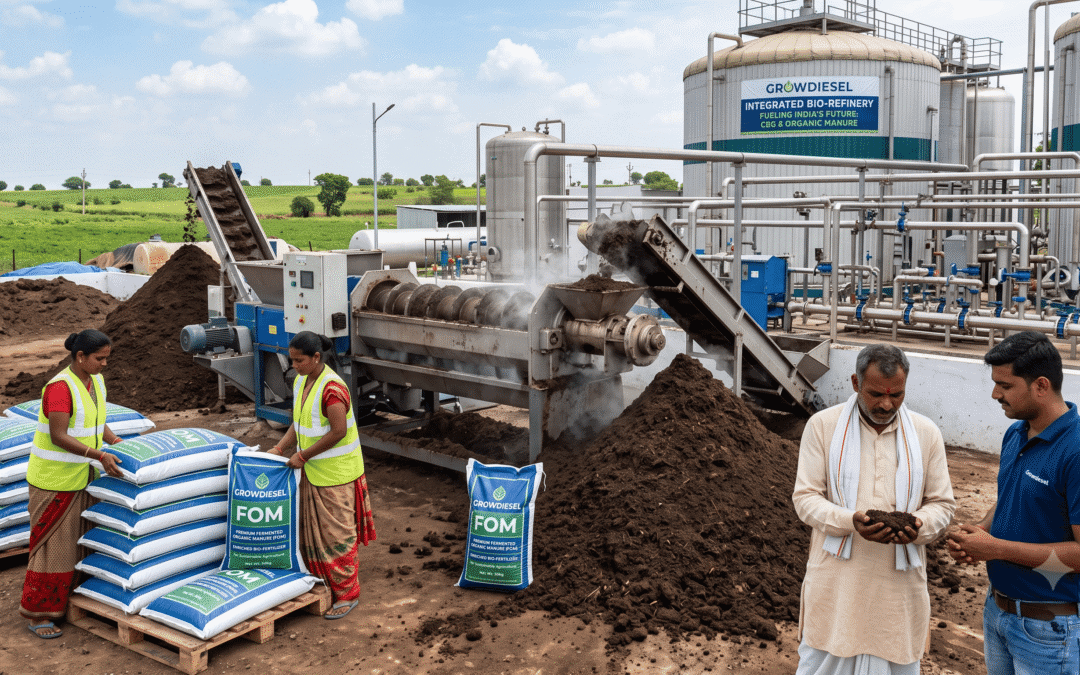
For most commercial Compressed Bio-Gas (CBG) plant operators, the primary commercial focus has traditionally been the gas: meeting offtake quotas, optimizing methane purity, and managing pipeline or cascade logistics.
As soil degradation worsens and chemical fertilizer prices stay volatile, Fermented Organic Manure (FOM) and Liquid Fermented Organic Manure (LFOM) are transforming from compliance byproducts into primary margin drivers.
The Economic Reality: Moving Beyond “Byproduct” Status
In a typical 100 TPD (tonnes per day) feedstock operation, every tonne of input generates a substantial volume of nutrient-rich solid digestate and liquid effluent. When processed and monetized correctly, FOM changes project unit economics:
-
Revenue Multiplier: Solid FOM (enriched and bagged) sells in wholesale agricultural corridors for ₹3,000 to ₹6,000 per tonne, while specialized liquid formulations command premium agro-retail prices.
-
Margin Cushion: FOM income operates largely independent of natural gas price fluctuations, creating a non-correlated cash flow stream that lowers project payback periods by 14–22%.
-
Government Push: Mandates under schemes like the Market Development Assistance (MDA) for promoting organic fertilizers provide financial support (such as ₹1,500/MT subsidies), actively closing the distribution gap for CBG developers.
Key Upgrades to Maximize FOM Realization
Raw digestate sitting in lagoons creates storage headaches and lost revenue. Top-performing CBG facilities employ three core upgrades:
-
Precision Dewatering & Liquid-Solid Separation
High-efficiency screw presses and decanter centrifuges separate solid fiber from the nutrient liquid fraction, reducing drying footprints and moisture variability.
-
Microbial Enrichment & Value Addition
Fortifying solid FOM with mycorrhiza, nitrogen-fixing bacteria (Azotobacter), and phosphorus-solubilizing bio-cultures elevates it from simple organic compost to premium bio-fertilizer.
-
Long-Term Offtake Packaging
Partnering directly with regional fertilizer marketing companies (FMCs) or local agricultural cooperatives locks in predictable 3- to 5-year bulk purchase agreements.
The Circular Bottom Line
A profitable CBG enterprise doesn’t stop at the nozzle. By treating digestate valorization with the same engineering rigor as methane scrubbing, bio-refinery operators secure both localized agricultural supply chains and resilient plant balance sheets.
Ready to evaluate your plant’s potential digestate output and total project ROI? Model your project metrics with the