
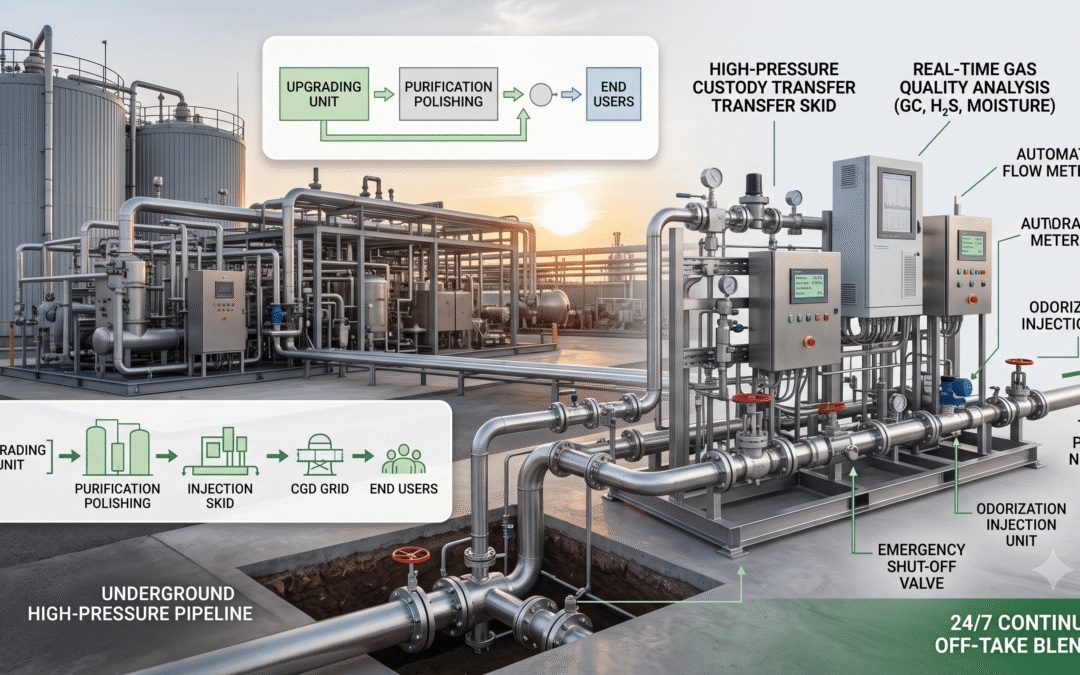
For most Compressed Biogas (CBG) plant operators, getting purified biomethane to off-takers relies on cascading cylinders, tractor-trailers, and physical road transport. While this “virtual pipeline” approach works during early-phase operations, it introduces fixed operational expenses, fuel costs, traffic delays, and strict volumetric limits per trip.
As India accelerates toward mandating CBG blending in City Gas Distribution networks, direct pipeline injection is transitioning from a high-tech option to a mainstream requirement. Connecting your Bio-CNG plant directly into CGD infrastructure shifts your delivery model from intermittent batch shipping to continuous, low-friction utility supply.
Key Requirements for CGD Grid Acceptance
CGD operators enforce strict gas quality thresholds to ensure pipeline integrity and safety. Biogas must undergo thorough scrubbing before grid injection:
-
Methane Content ($CH_4$): Must consistently exceed 90%–95% v/v, depending on the specific gas grid operator’s pipeline specification.
-
Hydrogen Sulfide ($H_2S$): Kept strictly below 5–10 ppm to prevent pipe corrosion and downstream equipment damage.
-
Carbon Dioxide ($CO_2$) & Oxygen ($O_2$): $CO_2$ reduced to $<3\%–4\%$, with $O_2$ strictly capped (typically $<0.5\%$).
-
Moisture / Dew Point: Complete gas drying to ensure water vapor does not condense under high pressure during seasonal temperature shifts.
-
Odorization: Injection of Mercaptan odorants at the custody transfer skid to meet standard safety protocols for natural gas distribution.
Strategic Advantages of Direct Grid Injection
+---------------------------+        +---------------------------+
|   Traditional Cascades    |        |    CGD Grid Injection     |
+---------------------------+        +---------------------------+
| • Road transit delays     |   VS   | • Continuous off-take     |
| • Fleet maintenance costs |        | • Lower transport OPEX    |
| • Strict batch limits     |        | • Scalable distribution   |
+---------------------------+        +---------------------------+
- Elimination of Transportation Overhead: Eliminating dedicated cascade fleets cuts long-term fuel, maintenance, and driver labor costs.
- 24/7 continuous Off-Take: Instead of managing inventory levels and tank pressure limits, the pipeline functions as a continuous buffer, reducing flaring or downtime during off-peak commercial hours.
- Long-Term Off-Take Contracts: CGD blending agreements provide bankable, long-term Off-take Agreements (Take-or-Pay contracts), making project financing and refinancing far easier to secure.
Implementing Smart Monitoring at the Interconnect Skid
Injecting biomethane into a third-party utility network requires real-time precision and automated control. Modern interconnect skids feature three core components:
-
Automated Gas Chromatographs (GC): Continuous online analysis of methane, carbon dioxide, $H_2S$, and moisture levels before gas enters the CGD network.
-
Emergency Shut-Off Valves (ESD): Automated valve isolation that immediately diverts off-spec gas back to the plant storage or upgrading unit before it contaminates the main line.
-
Digital Flow Metering & Telemetry: Remote monitoring systems that log custody transfer metrics, mass flow rates, and network pressures in real time.
Preparing Your Bio-CNG Infrastructure for Injection
- If your facility currently operates on local off-take or cascading models, upgrading to pipeline-ready standards involves three strategic steps:
- Conduct a Grid Proximity & Pressure Survey: Evaluate nearby CGD low-, medium-, or high-pressure steel lines to calculate required compressor ratings and interconnect distances.
- Upgrade Purification & Monitoring Equipment: Ensure membrane separation or PSA units feature secondary polishing loops to prevent $H_2S$ or moisture spikes.
- Establish Data Protocols: Integrate skid telemetry with your central control room to automate compliance logging and quality tracking.
Direct grid injection eliminates distribution limits for expanding Bio-CNG projects. Aligning plant purification, telemetry, and gas quality with CGD network standards ensures continuous off-take, lower operational overhead, and long-term project stability.