
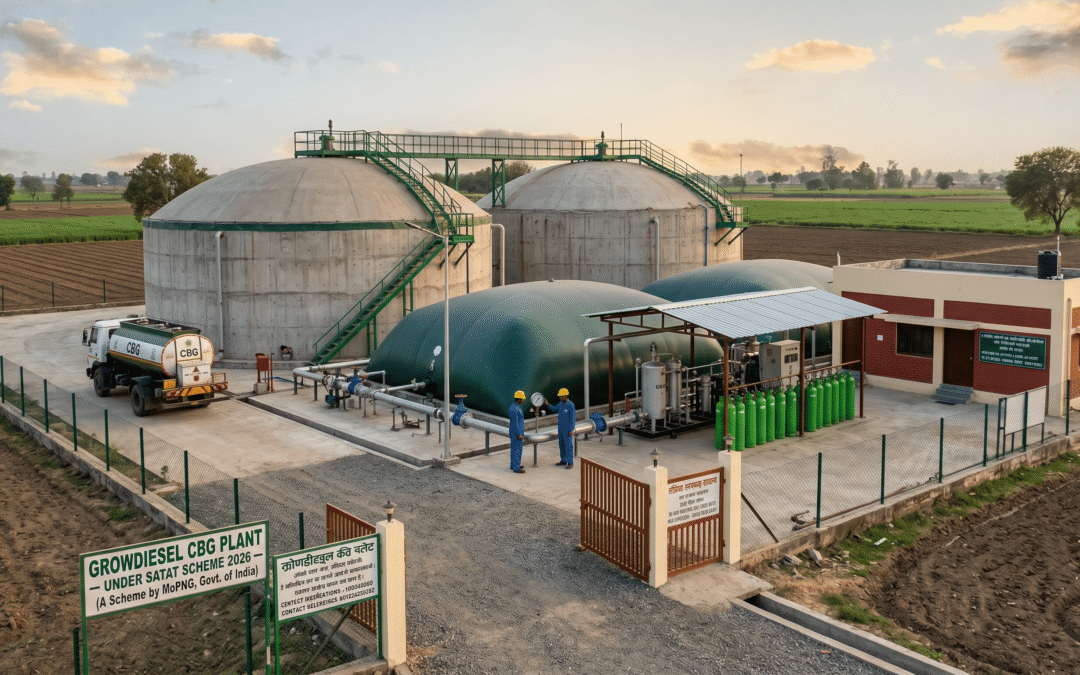
India’s clean energy revolution is accelerating at an unprecedented pace — and at the heart of it is the SATAT (Sustainable Alternative Towards Affordable Transportation) scheme. Launched by the Ministry of Petroleum and Natural Gas, SATAT was designed to procure Compressed Biogas (CBG) from entrepreneurs and channel it into the national CNG grid. In 2026, with India’s Bio-CNG blending mandate now live and government procurement targets climbing, the SATAT scheme has become the single most important gateway for CBG plant developers across the country.
If you’re planning to set up a biogas-to-CBG plant and want to sell directly to Oil Marketing Companies (OMCs) like Indian Oil, BPCL, or HPCL — this guide is for you.
What is the SATAT Scheme?
The SATAT scheme was launched in October 2018 with an ambitious target of setting up 5,000 CBG plants across India by 2023. The target has since been revised and extended to 2025–26, with the government now aiming for a combined CBG production capacity of 15 million metric tonnes per annum (MMTPA). Under SATAT, entrepreneurs set up CBG plants and sell the produced gas to OMCs at a government-notified price. The scheme provides a guaranteed off-take agreement, making it one of the most investor-friendly green energy programs in the world.
Why 2026 is the Best Time to Apply
Several policy tailwinds are now converging to make 2026 an ideal year to apply for a CBG plant under SATAT:
- The 1% CBO (Compressed Biogas Obligation) blending mandate is now legally enforceable, creating mandatory demand for CBG.
- The Union Budget 2026 extended the excise duty exemption on CBG, significantly improving plant economics.
- MNRE and MoPNG have unlocked priority bank financing for SATAT applicants under green energy lending norms.
- Carbon credit monetisation pathways are now formally recognised, adding a supplementary income stream for CBG producers.
- Fermented Organic Manure (FOM) — the by-product of CBG production — now commands a market price of ₹8–12 per kg under PMPKSY, dramatically improving plant ROI.
Eligibility Criteria for SATAT CBG Plant License
To apply under the SATAT scheme, the applicant must meet the following minimum eligibility criteria:
- Must be a registered company, LLP, partnership firm, or proprietorship in India.
- Must demonstrate access to or ownership of feedstock (agricultural residue, municipal solid waste, press mud, etc.) within a 25 km radius of the proposed plant site.
- Must have secured or be in the process of securing land for the plant (minimum 2 acres for a 5 TPD plant).
- Net worth requirement varies by plant capacity — typically ₹1–2 crore for a 5 TPD plant.
- No prior criminal conviction related to financial fraud.
Step-by-Step: How to Apply for a SATAT CBG License
Here is the complete application process as of 2026:
Step 1: Register on the SATAT Portal
Visit the official SATAT portal managed by Indian Oil Corporation (IOCL) and register as a new applicant. You will need a valid PAN, GST number, and a company registration certificate.
Step 2: Submit a Letter of Intent (LOI)
Submit an LOI to your nearest OMC zonal office (IOCL, BPCL, or HPCL). The LOI must include: proposed plant location, estimated daily CBG output (in kg/day), primary feedstock source, and land ownership or lease documents.
Step 3: Feasibility Assessment & OMC Approval
The OMC will evaluate your LOI based on feedstock availability, location viability, and grid connectivity. This assessment typically takes 30–60 days. Upon approval, you receive a Letter of Approval (LOA).
Step 4: DPR Submission
Prepare and submit a Detailed Project Report (DPR) covering: plant design, technology selection (wet fermentation vs. dry fermentation), CAPEX breakdown, projected revenue, and environmental clearance plan.
Step 5: Environmental & State Clearances
Apply for consent to establish (CTE) from the State Pollution Control Board. For plants processing more than 5 TPD, an Environmental Impact Assessment (EIA) may be required.
Step 6: Sign the CBG Purchase Agreement (CPA)
Once all clearances are in place, sign the CBG Purchase Agreement with the OMC. This is the definitive off-take agreement guaranteeing purchase of your CBG output at the notified price.
Step 7: Financial Closure & Construction
Key Documents Required
Before applying, keep the following documents ready:
Site map and Google coordinates of proposed plant location
SATAT CBG Pricing: What Will OMCs Pay You in 2026?
As of 2026, the administered price for CBG sold to OMCs under SATAT is in the range of ₹54–58 per kg, depending on the procurement zone and feedstock category. This is separate from any carbon credit revenue and FOM sales, which can add another ₹8–15 per kg equivalent to your effective per-unit realisation. For a 5 TPD plant producing approximately 500 kg of CBG per day, this translates to a gross revenue potential of ₹2.7–2.9 lakh per day from CBG alone — making the SATAT route one of the most financially compelling green energy businesses available to Indian entrepreneurs today.
Common Mistakes to Avoid
Many first-time SATAT applicants make avoidable mistakes that delay or derail their project. Here are the most common pitfalls:
Delaying environmental clearances: Start the CTE/CTO process in parallel with the LOI — not after.
Final Takeaway: SATAT is India’s Most Accessible Green Energy License
The SATAT scheme remains the most structured, government-backed, and financially rewarding entry point into India’s CBG sector. With guaranteed off-take from OMCs, access to subsidised financing, and multiple revenue streams — from CBG sales to carbon credits to FOM — the SATAT route offers a risk-adjusted return profile that is hard to match in any other renewable energy category.
At Growdiesel, we help entrepreneurs and investors navigate every step of the SATAT application process — from initial feasibility analysis and DPR preparation to technology selection and financial modelling. Whether you’re starting from scratch or looking to scale an existing project, our team is ready to help you unlock India’s biogas opportunity.
Get in touch with us today to start your SATAT journey.Apply for project financing under MNRE or NABARD green energy schemes. Upon financial closure, begin plant construction with your chosen technology provider.
Underestimating feedstock logistics: Committing to a feedstock supply that is seasonal or geographically dispersed beyond 25 km drives up operating costs significantly.
Choosing wrong technology: Not all biogas technology providers are equipped to achieve the >90% methane purity required for CBG. Always verify with pilot data.
Skipping the DPR: A poorly prepared DPR is the single biggest reason for OMC rejections and bank loan delays.
Ignoring FOM monetisation: Projects that don’t plan FOM storage, packaging, and sales leave significant revenue on the table.
Company registration certificate (MCA)
PAN card of company and directors
GST registration certificate
Board resolution authorising the application
Land documents (sale deed / lease agreement)
Feedstock availability certificate or MoU with feedstock supplier
Audited financial statements (last 2 years)
Net worth certificate from a CA