
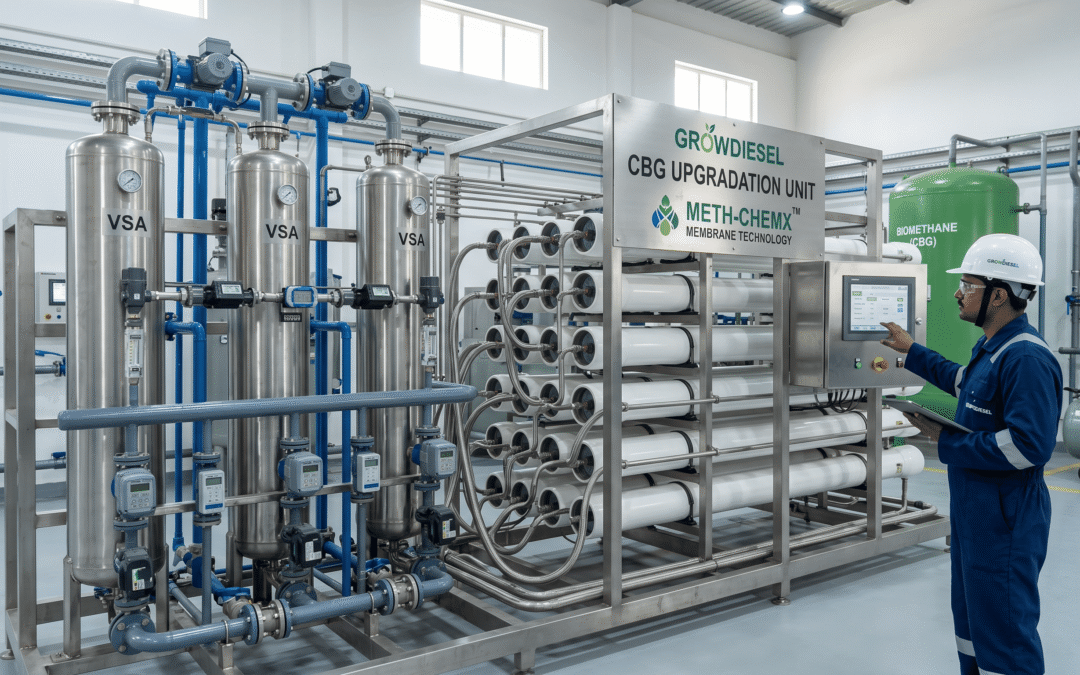
The global energy landscape is undergoing a massive shift, and the numbers speak for themselves. With India’s newly enforced 1% Compressed Biogas Obligation (CBO) blending mandate on an aggressive ramp-up curve toward 5% by 2029—backed by complete Central Excise Duty exemptions—the Bio-CNG sector has officially transitioned from a green initiative into a highly profitable, high-stakes commercial market.For modern green entrepreneurs and project developers, the question is no longer about finding a buyer. Oil Marketing Companies (OMCs) and City Gas Distribution (CGD) networks are legally hungry for gas.
Instead, the million-dollar question is: Can your plant deliver the volume and strict gas purity required to feed the grid without corroding the infrastructure?
To win the 2026 “Bio-CNG Gold Rush,” plants are rapidly ditching yesterday’s water-scrubbing methods and turning to advanced upgradation tech stacks. Here is a breakdown of how cutting-edge technology, automation, and proprietary systems like Growdiesel’s Regwell™ and Meth-ChemX™ are redefining plant efficiency and driving massive ROI.
The Purity Problem: Why Standard Upgrading Fails
Raw biogas generated from anaerobic digestion is far from ready for a vehicle engine or a commercial pipeline. It typically sits at roughly 55% to 60% methane (
If you feed low-grade gas into a pipeline, $H_2S$ combined with moisture forms sulfuric acid, destroying valves and triggering severe engine corrosion. To pass the stringent IS 16087:2016 quality standards, a plant must upgrade raw gas into high-purity biomethane (
1. VSA & Advanced Polymer Membranes: The High-Flow Kings
While traditional water and chemical scrubbing systems were once the industry norm, they often demand high operational costs (OpEx) and struggle with high flow rates. Enter Vacuum Swing Adsorption (VSA) and modern multi-stage Polymer Membrane Separation.
These systems work by separating gas molecules at a microscopic level based on their molecular size and permeability rates.
-
Seamless Volume Management: Advanced membrane configurations effortlessly handle complex, high-velocity streams (scaling past $350 \text{ m}^3\text{/h}$ of raw gas).
-
The Purity Payoff: By selectively stripping away
$CO_2$ and nitrogen, these advanced separation systems consistently yield ultra-pure biomethane.
At Growdiesel, our proprietary Regwell™ Industrial-Grade Bio-CNG Technology combined with our Meth-ChemX™ purification systems pushes the envelope even further, elevating raw biogas to an exceptional 96% to 98%+ methane purity standard, making it instantly ready for commercial blending and distribution.
2. Automation and IoT: The “Brain” of the Digester
A Bio-CNG plant isn’t just a mechanical refinery; it is a sensitive biological ecosystem. The anaerobic bacteria inside your digesters require strict environmental stability. A sudden drop in temperature or an unmonitored chemical spike can completely stall gas production, resulting in devastating downtime.
Modern plants are solving this vulnerability by deploying end-to-end industrial automation and Internet of Things (IoT) sensors that monitor the digester’s health in real-time.
[IoT Sensors] ---> [Real-time Analytics] ---> [Automated Adjustments]
(pH, VFA, Temp)     (Predictive Alerts)        (Feeding & Heating)
[IoT Sensors] ---> [Real-time Analytics] ---> [Automated Adjustments]
(pH, VFA, Temp) (Predictive Alerts) (Feeding & Heating)
Key biological metrics tracked continuously include:
-
pH Levels: Ensuring the environment doesn’t become too acidic for methanogenic bacteria.
-
Volatile Fatty Acids (VFA) to Alkalinity Ratio: The ultimate early-warning indicator for organic overloading or digester “sourness.”
-
Temperature Fluctuations: Keeping mesophilic or thermophilic zones locked within strict decimal ranges.
By feeding this live data into an automated control loop, the plant can automatically adjust feeding cycles, mixing speeds, and heating elements—preventing biological failures before they happen and ensuring an uninterrupted, consistent gas output.
3. Turning Data into Bankable Blueprints
Operating at peak efficiency requires syncing your physical hardware with digital intelligence. As regulatory compliance tightens and multi-feedstock profiles (like mixing cow dung, press mud, and agri-residues) fluctuate, static spreadsheets are no longer enough to manage a plant’s variables.
To close this gap, Growdiesel projects are paired with our digital intelligence partner, BiogasFlux.com.
BioFlux acts as a predictive analytics suite for your plant, mapping out month-by-month financial forecasts, calculating exact volatile solids (VS) destruction rates, and accounting for the latest 2026 tax logic.
Bottom Line: Don’t Just Build a Plant. Build an Advanced Refinery.
The Bio-CNG industry has evolved past basic waste management. Today, it is an advanced chemical engineering sector where fractions of a percent in methane recovery dictate your bottom line. By leveraging smart automation, robust VSA or membrane purification, and Growdiesel’s industry-leading technology, developers are protecting their infrastructure while maximizing their revenue streams from both premium gas and nutrient-rich Fermented Organic Manure (FOM).
Ready to transition from waste to predictable wealth?
Whether you are looking to launch a new 5 TPD facility or optimize a massive 20 TPD multi-feedstock industrial refinery, our expert EPC team is here to guide you.
👉
👉 To run a technical ROI simulation instantly in your preferred currency and language, visit our precision modeling engine at