
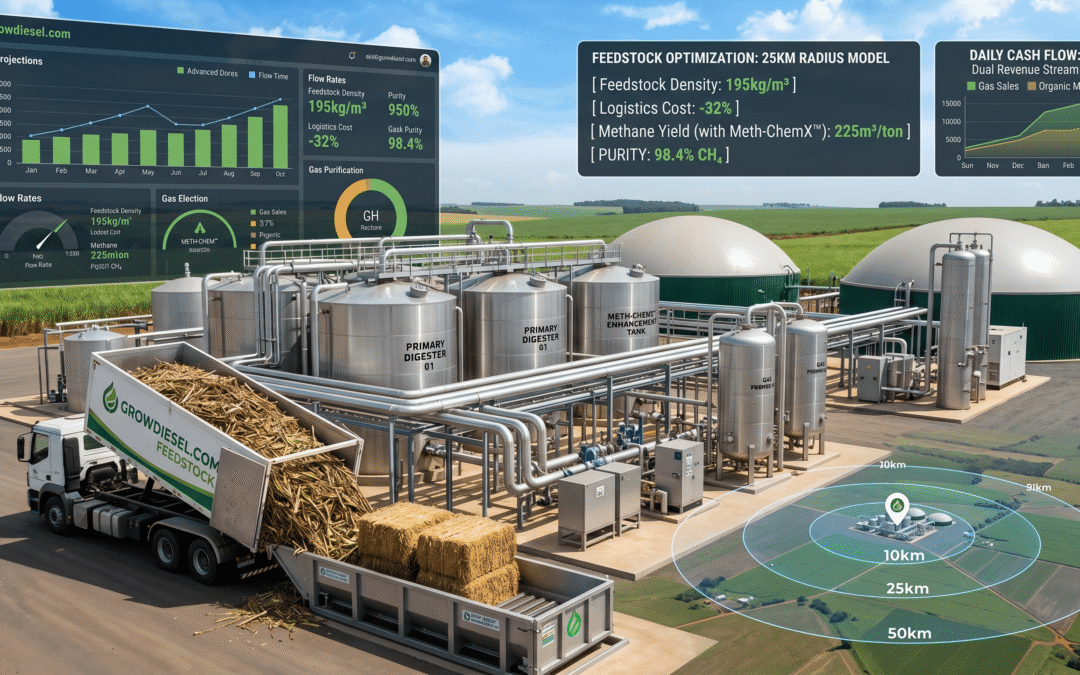
For any developer scaling a Compressed Biogas (CBG) facility under the mandatory Compressed Biogas Obligation (CBO) mandates, the math on paper looks incredibly attractive.
But as dozens of commercial plants move from architectural blueprints to actual daily operations, a cold industrial reality is setting in: The Battle for Profitability Is Won or Lost in the Logistics Radials.
If you are calculating your plant’s internal rate of return (IRR) based purely on the cost of biomass at the source, your financial model contains a critical blind spot. To scale predictably without cannibalising margins, you must master the physics and material science of biomass transport.
1. The Logistical Ceiling: Why Low-Density Biomass Destroys Margins
The fundamental problem with raw agricultural waste—whether it is loose paddy straw, cotton stalks, or sugarcane trash—is its bulk density.
Raw, uncompressed crop residue typically possesses a bulk density of less than 60 kilograms per cubic meter ($60\text{ kg/m}^3$). When you load loose biomass onto a commercial flatbed truck, you aren’t running out of weight capacity; you are running out of physical volume.
The Empty Truck Trap: You are essentially paying to transport trapped air across state highways.
If your feedstock collection radius expands beyond 25 to 30 kilometers from your digester dome, diesel costs, labor, and payload inefficiencies quickly turn free or cheap biomass into a financially unviable liability.
The Solution: Strategic Densification Engineering
To build a truly resilient feedstock network, project developers must transition from simple material transport to an active feedstock densification strategy at the regional level. By utilizing localized aggregation hubs equipped with industrial baling, pelletizing, or briquetting machinery, operators can force bulk densities upward:
| Feedstock Form | Average Bulk Density | Maximum Economic Transport Radius |
| Loose Paddy Straw | $\sim 50 – 60\text{ kg/m}^3$ | Less than 25 km |
| High-Density Bales | $\sim 180 – 200\text{ kg/m}^3$ | Up to 60 km |
| Pellets / Briquettes | $\sim 550 – 650\text{ kg/m}^3$ | 120+ km |
Overcoming Lignin Resistance via Advanced Biochemistry
While densification solves the transit problem, compressing complex agricultural waste introduces a secondary technical challenge: microbial accessibility. High-density, woody stalks are heavily bound by lignin—a natural organic polymer that blocks anaerobic bacteria from easily breaking down the inner cellulose structure.
If you dump highly dense, untreated briquettes or bales directly into a standard digester, the hydraulic retention time (HRT) skyrockets, causing massive unfermented waste buildup and a severe drop in daily methane production.
At Growdiesel, we solve this structural bottleneck natively using our proprietary Meth-ChemX™ catalytic pre-treatment engine.
Meth-ChemX™ works at a molecular level to break the stubborn lignin bonds protecting dense biomass before it ever reaches the primary digestion phase. This chemical acceleration accomplishes two major operational goals:
- It drastically reduces digestion retention times.
- It unlocks a 20% to 30% increase in pure gas yields from dense, high-lignin agricultural residues that traditional systems struggle to process.
Simulating Your Supply Chain with Absolute Precision
Because feedstock availability, localized moisture content, and regional transportation tariffs fluctuate constantly, navigating these complex operational margins requires sophisticated calculation engines.
To help our global partners model these exact logistics dynamics without friction, we have completely updated the multi-currency reporting capabilities at BiogasFlux.com.
Before breaking ground or signing a feedstock contract, developers can map localized tipping fees, fluctuating bulk density variables, and multi-layered transport radials across 10 different languages and 4 major international currencies. The platform generates institutional-grade, scannable data visualization reports that project exactly how your logistics infrastructure affects your 10-year operational cash flow.
In the high-stakes clean energy frontier, intuition is a liability. True competitive advantage belongs to the operators who treat biomass sourcing not as a farming chore, but as a precise engineering discipline.