
Have you ever wondered what happens to the food scraps you throw away, or the waste produced on livestock farms? Instead of letting it sit in a landfill where it releases harmful greenhouse gases into the atmosphere, we can trap that waste and turn it into clean, renewable energy.
This process happens inside a biogas plant.
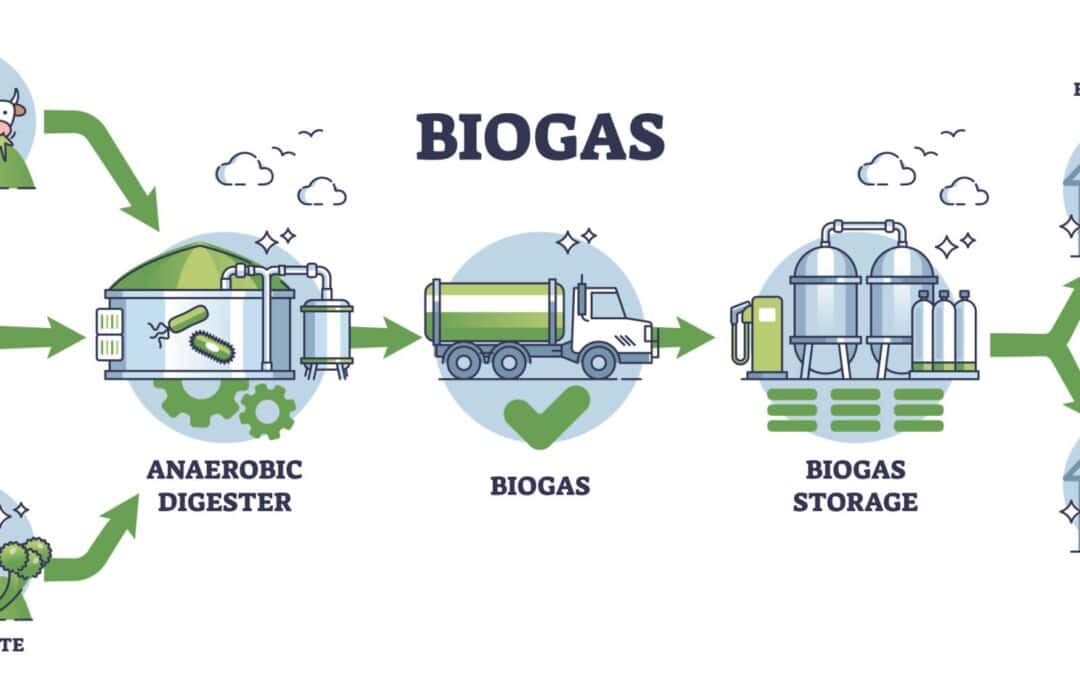
To truly understand how this system takes raw organic matter and converts it into electricity, heat, and fertilizer, it helps to visualize the physical flow of the entire operation.
1. The 4-Step Flow of a Biogas Plant
A biogas plant is essentially an engineered stomach. It takes in food, digests it in an environment without oxygen, releases gas, and leaves behind nutrient-rich leftovers. Let’s break down exactly how it flows from left to right as shown in the diagram.
Step 1: Gathering the Feedstock (The Input)
The process begins on the far left with the raw materials, collectively known as feedstock. A biogas plant can process a wide variety of organic matter:
-
Slurry: Animal manure and wastewater from dairy or livestock farms.
-
Food Waste: Leftovers from households, commercial kitchens, and food processing factories.
-
Energy Crops: Specific plants like maize or grasses grown explicitly for biomass production.
These materials are collected and mixed together in a large reception pit to create a consistent, pumpable mixture before it enters the main system.
Step 2: The Anaerobic Digester (The Stomach)
Next, the mixture is pumped into the heart of the plant: the Anaerobic Digester. This is a massive, sealed, airtight dome tank.
Because there is zero oxygen inside this tank, a specialized group of anaerobic bacteria goes to work breaking down the organic material. This biological breakdown process is called anaerobic digestion. The tank is continuously stirred and kept heated (usually around 38°C to 55°C) to keep the bacteria happy and multiplying.
As the bacteria “eat” the waste, they release gas. Because gas is lighter than liquid, it naturally rises to the top of the dome tank, while the heavy solids sink to the bottom.
Step 3: Biogas Collection & Storage
The gas collected at the top of the dome is Biogas—a mixture primarily made of methane ($CH_4$, about 50–70%) and carbon dioxide ($CO_2$).
As seen in the center of the diagram flow, the gas is safely piped out of the digester tank and sent to Biogas Storage units. Before it can be used, the gas often goes through a quick cleaning process to remove moisture and trace impurities like hydrogen sulfide ($H_2S$), which can corrode engines.
Step 4: End Products (The Output)
Nothing goes to waste in a biogas plant. The system yields two incredibly valuable outputs on the far right of the process flow:
- Energy (Gas & Electricity): The cleaned biogas is routed to a Combined Heat and Power (CHP) unit. This unit burns the gas to turn a turbine, generating electricity for the power grid and heat for local heating systems. Alternatively, the gas can be highly purified into Renewable Natural Gas (RNG) and injected directly into gas lines or used as vehicle fuel.
- Digestate (Organic Fertiliser): The leftover solid and liquid material that the bacteria couldn’t break down settles at the bottom of the digester. This material, called digestate, is packed with nitrogen, phosphorus, and potassium. It is pumped out and used by farmers as a high-grade, completely organic fertiliser, closing the loop of the circular economy.
Why Biogas is a Double Win for the Environment:
When manure and food waste rot openly in a field or landfill, they release methane directly into the atmosphere—a gas over 25 times more potent at trapping heat than carbon dioxide. By trapping that methane inside a biogas plant instead, we prevent pollution and offset the need for fossil fuels simultaneously.
Maximise Your Plant’s Potential with Biogasflux
Understanding the basic flow is just the first step. Operating a modern biorefinery requires precise tracking, international compliance, and deep data analytics.
Whether you are designing a new system or managing an active facility,
Ready to scale your bio-fuel operation? Explore the smart way to manage bio-energy at