
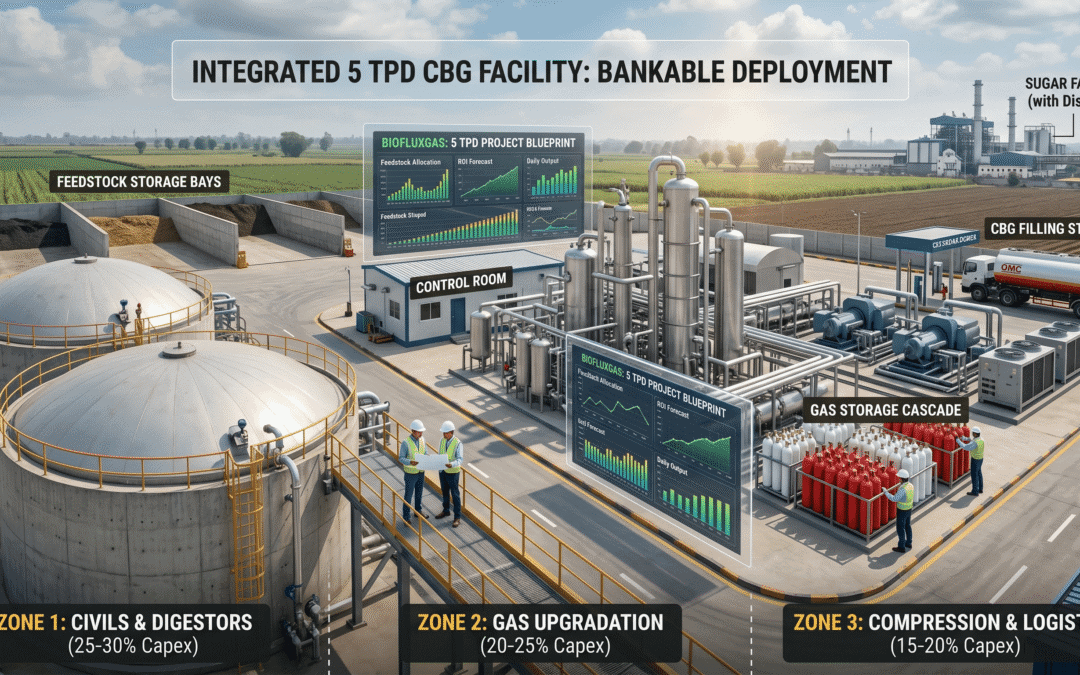
Establishing a Compressed Biogas (CBG) plant is rapidly transitioning from an environmental corporate social responsibility (CSR) target into one of the most high-performing, subsidy-backed asset classes in the energy sector.
For institutional investors, sugar factories, and large-scale agricultural entrepreneurs, the primary barrier to entry isn’t interest—it is understanding the raw Capital Expenditure (Capex) architecture required to take a 5 TPD (Tons Per Day) industrial facility from ground-breaking to full commercial operation.
Below is an analytical breakdown of the core investment pillars, structural allocations, and strategic risk-mitigation routes essential for a bankable Detailed Project Report (DPR).
1. The Core Infrastructure Breakdown
A standard 5 TPD commercial refinery demands a comprehensive approach to site layout and technology selection.
A. Civil Works and Structural Footprint
Site development requires a layout that optimizes logistical entry and biological flow.
B. Anaerobic Digestion and Biochemical Technology (The Reactor)
The biological core of the plant demands highly efficient design.
C. Gas Scrubbing and Upgradation Systems
To generate vehicle-grade fuel or meet the strict criteria required for Oil Marketing Company (OMC) gas-grid injection, raw biogas must be scrubbed to remove
2. Strategic Variables Shifting the Financial Blueprint
Two identical 5 TPD facilities can feature entirely different payback timelines based on two foundational variables:
The Feedstock Premium
A plant built next to a continuous supply of press mud or spent wash from an active sugar distillery features radically simplified procurement logistics compared to an urban municipal solid waste (MSW) sorting facility.
The Opex-Capex Paradox
Opting for lower-cost purification equipment can save initial budget during the construction phase, but it often surfaces later as a long-term strain on Operating Expenditures (Opex). Systems with high methane slippage vent valuable gas out with the waste streams, permanently impacting daily top-line revenues. Investing in advanced, low-parasitic-load technology blocks ensures lower daily operational costs over a 20-year lifecyle.
3. Unlocking Capital Assets: Subsidies and Secondary Revenues
The viability of modern commercial biofuel projects is heavily enhanced by strong government frameworks and evolving global carbon dynamics:
- Central Financial Assistance (CFA): Eligible project developers can access significant government capital subsidies—often scaling up to ₹10 Crore per project—directly lowering initial debt requirements.
- The Organic Fertilizer Multiplier: High-yield anaerobic digestion processes yield tons of nutrient-rich by-products.
Upgrading this output into solid Fermented Organic Manure (FOM) or Phosphate Rich Organic Manure (PROM) opens a major agricultural market stream that can account for up to 30% of total plant earnings. - Digital Carbon Credit Monetization: By utilizing real-time, internet-of-things (IoT) tracking across your plant infrastructure, modern facilities automatically generate high-integrity carbon offsets.
These are increasingly liquid assets traded on global blockchain-backed exchanges, creating a highly stable USD-denominated revenue stream.
3. Partnering for Commercial Scale
Building an industrial-grade bio-refinery demands deep technical integration across mechanical, biological, and financial engineering layers.
Growdiesel brings over two decades of technical expertise, having designed and launched pioneering waste-to-energy frameworks across India.
To simulate immediate technical output scenarios and test custom feedstock mix allocations online, access our analytics workspace at BiogasFlux.com