
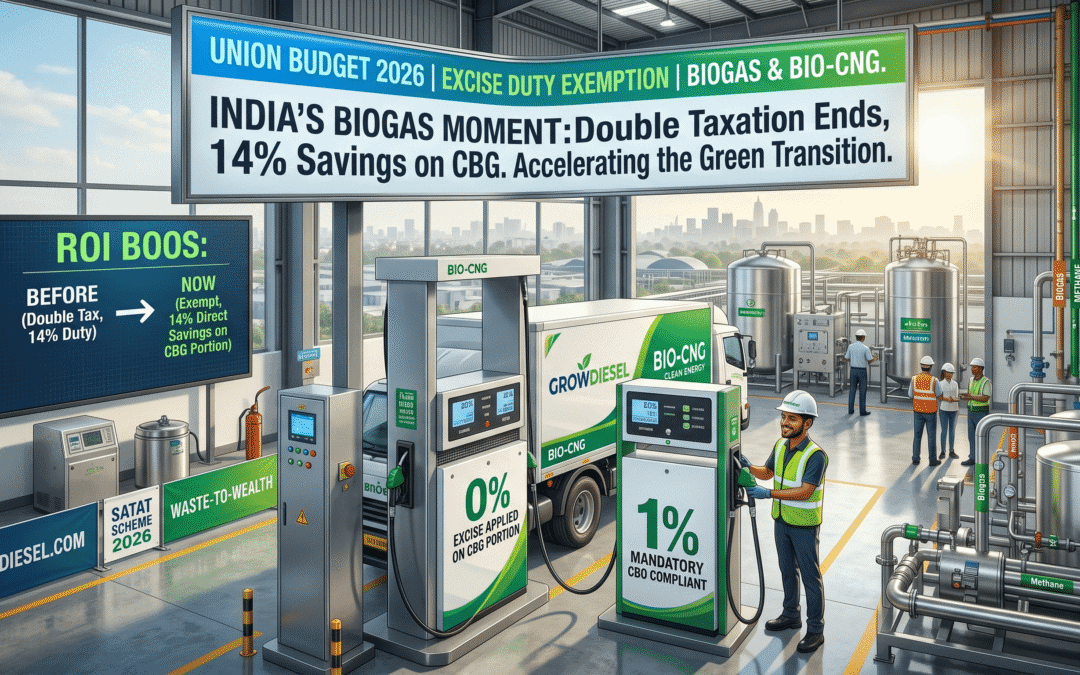
For years, the Indian biogas industry has fought a silent battle against an invisible enemy: Double Taxation.
While the world talked about Net Zero 2070, Indian Bio-CNG (CBG) producers were stuck in a fiscal loop—paying GST on their production and then seeing their product hit with an additional 14% Central Excise Duty when blended with fossil CNG.
As of February 2, 2026, that barrier has officially crumbled.
With the implementation of Notification No. 02/2026-Central Excise, the Government of India has finally provided the fiscal “oxygen” the industry needs. If you are an investor, a plant owner, or a corporate leader in the energy space, here is why this budget reform is a total game-changer for your ROI.
1. The Death of “Double Taxation”
Before this reform, the valuation of blended CNG included the cost of the Biogas portion, which had already attracted GST. This meant the industry was effectively being taxed twice on the same molecule.
The new policy creates a “Clean Value Path”:
-
The Rule: The value of Biogas/CBG is now excluded from the transaction value when calculating Central Excise Duty on blended CNG.
-
The Result: A direct reduction in the tax burden, allowing CBG to compete head-to-head with fossil fuels on price without sacrificing producer margins.
2. Timing the 1% Blending Mandate
This tax relief didn’t happen in a vacuum. It arrived just as the Compressed Biogas Obligation (CBO) transitioned from voluntary to mandatory in April 2026.
City Gas Distribution (CGD) companies are now legally required to blend 1% CBG into their networks. By removing the excise duty on that 1% volume, the government has made compliance profitable. CGD giants like GAIL and IGL no longer see blending as a “penalty cost” but as a smart fiscal move to lower their overall tax liability.
3. Unlocking the ₹1 Lakh Crore Investment Pipeline
According to the Indian Biogas Association (IBA), this single policy shift—if maintained with stability—can unlock up to ₹1,00,000 Crore in private investment.
Why? Because it fixes the Internal Rate of Return (IRR) for mid-to-large scale plants. A typical 5 TPD to 10 TPD plant that was previously “marginal” or “risky” on paper is now suddenly a high-yield asset thanks to the 14% cushion created by the excise exemption.
What This Means for You:
-
For Investors: The “Policy Risk” of biogas has plummeted. The alignment between the Ministry of Finance and the Ministry of Petroleum (MoPNG) is the clearest it has been in two decades.
-
For Plant Owners: Your off-take agreements with OMCs and CGD companies are about to become more lucrative. Demand for high-purity CBG will outstrip supply throughout 2026.
-
For the Planet: A 10% nationwide blend could lower emissions by nearly 15 million tons of $CO_2$ equivalent annually.
The Bottom Line
At Growdiesel, we’ve always believed in turning “Waste into Wealth.” For a long time, the “Wealth” part was hampered by complex tax structures. With the 2026 Excise Exemption, the government has finally cleared the road.
The “Gold Rush” for green energy isn’t coming—it’s already here.
Ready to Optimise Your Project?
The new tax landscape requires updated financial modelling. Use our BioFlux Project Calculator to see how the 2026 excise changes and the 1% mandate affect your specific plant’s ROI and payback period.