
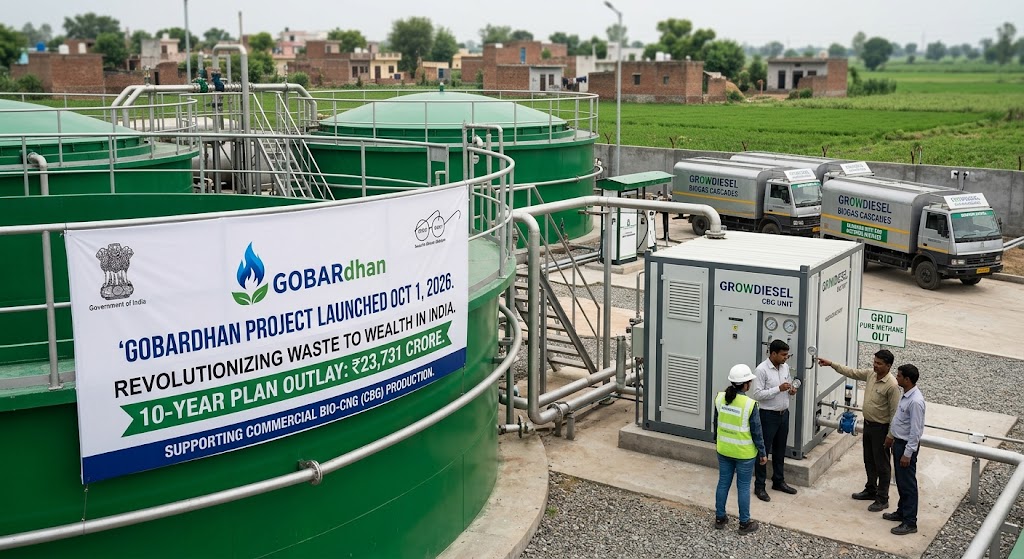
In a major policy milestone for India’s clean fuel ecosystem, Union Minister for Petroleum and Natural Gas, Shri Hardeep Singh Puri, formally launched the unified ₹23,731 Crore GOBARdhan Central Sector Scheme on October 1, 2026, alongside the release of the official GOBARdhan Handbook and the Unified Digital Portal.
Replacing fragmented legacy mechanisms, this new 10-year national roadmap (FY 2026–27 to FY 2035–36) is engineered to solve the three chronic bottlenecks of the Indian Compressed Biogas (CBG) sector: pricing volatility, grid offtake uncertainty, and heavy initial Capex.
Targeting a 10-fold increase in domestic CBG output, this launch establishes Compressed Biogas as a bankable infrastructure asset class.
What the New GOBARdhan Scheme Brings: At a Glance
| Policy Parameter | Legacy Landscape (SATAT & Early Frameworks) | New GOBARdhan Framework (Launched Oct 2026) |
| Total Outlay | Fragmented across departments/initiatives | ₹23,731 Crore unified central outlay |
| Capital Assistance | Fixed subsidies with extensive appraisal queues | Up to ₹2 Crore per Ton Per Day (TPD) installed capacity |
| CBG Pricing | Periodic revisions; fluctuating OMC purchase contracts | Administered ₹2,110/MMBtu (~₹105/kg) for a 10-year horizon |
| Offtake Security | Best-effort MOUs; off-take logjams | Statutory CGD Blending Obligation (CBO): 3% to 5% mandatory quota |
| Nodal Body | Multi-ministerial coordination (MNRE, Jal Shakti, MoPNG) | Ministry of Petroleum and Natural Gas (MoPNG) direct execution |
| Infrastructure Link | Cascade-only trucking reliance | Pipeline connectivity support to CGD networks & trunk lines |
The 6 Core Pillars of the ₹23,731 Crore Scheme
1. Capital Assistance Up to ₹2 Crore / TPD
Under the unified framework, eligible greenfield plants—as well as brownfield capacity expansions—can access capital support capped at ₹2 Crore per TPD of installed CBG capacity.
-
Broader Coverage: Unlike prior capital subsidies limited strictly to digestion tanks, assistance now covers critical value-chain machinery, including biomass collection/aggregation hardware and Fermented Organic Manure (FOM/LFOM) processing units.
2. A 10-Year Assured Base Price: ₹105 / kg
Historically, financiers hesitated to sanction 10-year term debt due to fluctuating gas purchase agreements. The scheme institutes a national benchmark administered price of ₹2,110 per MMBtu (~₹105/kg of pure CBG) guaranteed across a 10-year horizon, locking in project revenue predictability.
3. Enforceable Mandatory Blending (CBG Obligation)
The Ministry has linked procurement mandates directly to City Gas Distribution (CGD) entities supplying transport CNG and domestic piped natural gas (PNG):
-
FY 2026–27: 3% mandatory blend
-
FY 2027–28: 4% mandatory blend
-
FY 2028–29 Onwards: 5% mandatory blend
CGD networks are required to execute binding offtake agreements within three months of receiving a complete developer application.
4. Direct Pipeline Injection & Grid Connectivity
Truck cascades at 250 bar incur continuous diesel and logistics overheads. The new scheme sets aside dedicated funding to co-finance direct pipeline interconnects linking cluster-based or standalone CBG plants directly into city gas grids and trunk transmission pipelines.
5. Credit Guarantee Support for MSMEs & Enterpreneurs
To lower the cost of capital for new entrants, a sovereign-backed credit guarantee mechanism shares collateral risk with scheduled commercial banks, streamlining loan approvals under Priority Sector Lending (PSL).
6. CBG Ecosystem Challenge Fund
Recognizing that 70% of plant operational failures stem from biomass supply disruptions, this fund targets district-level feedstock mapping, rural aggregation hubs, and downstream marketing of organic fertilizers.
What Developers and Industrialists Should Do Right Now
With the launch of the Unified GOBARdhan Portal, applications are live.
- Verify Land Zonation & Logistics: Secure non-agricultural (CLU) industrial land located within 25–35 km of your primary biomass source (paddy straw, pressmud, cow dung, or food processing slurry).
- Standardize the DPR: Structure your Detailed Project Report around the official ₹2,110/MMBtu benchmark and current capital assistance formulas.
- Register on the Unified Portal: Complete entity onboarding and secure early-stage in-principle clearance for grid synchronization.
Engineer Your Bio-CNG Project with Growdiesel
The October 1 GOBARdhan scheme represents a generational shift for bio-energy in India.
Growdiesel provides turnkey engineering, procurement, and construction (EPC) solutions, high-rate anaerobic digestion systems, and end-to-end DPR advisory aligned with the latest MoPNG regulations.
Reach out to the Growdiesel engineering team today to conduct your site feasibility study and structure a bankable DPR under the new ₹23,731 Cr GOBARdhan policy.