
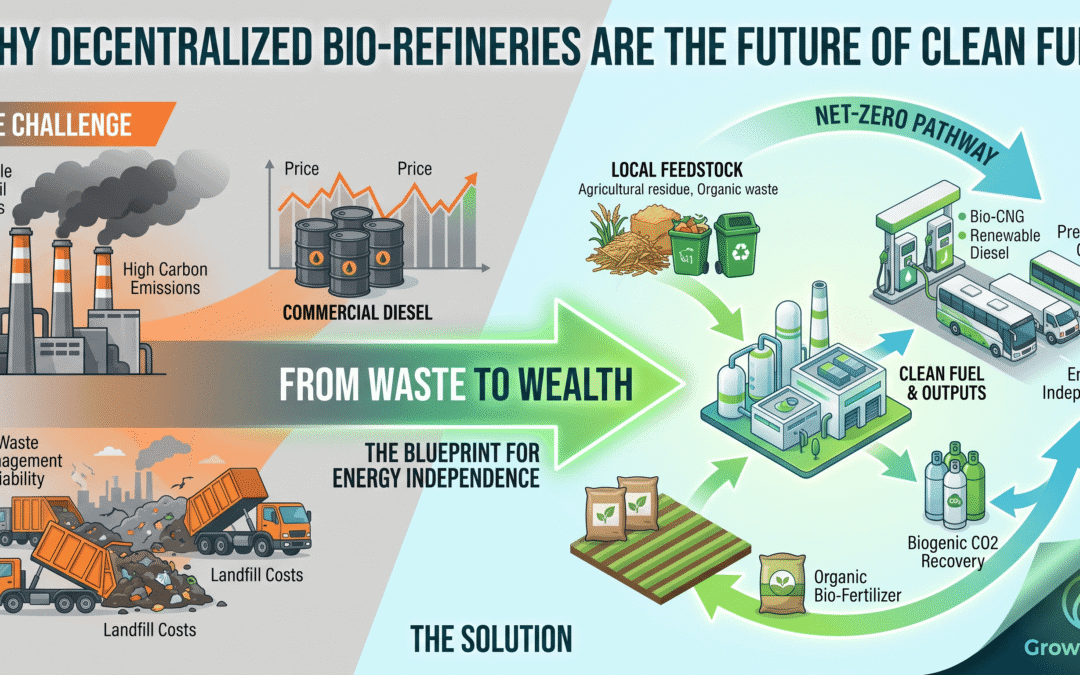
The global push toward Net-Zero is forcing a fundamental shift in how industries generate, consume, and manage energy. For decades, businesses and municipalities treated waste as a costly disposal problem while relying entirely on volatile fossil fuel supply chains.
Today, advanced decentralized bio-refineries are rewriting this dynamic—turning organic waste, agricultural residue, and industrial biomass into drop-in renewable fuels on-site.
The Flaws of the Centralized Energy Model
Heavy industries, transport fleets, and manufacturing hubs face three escalating bottlenecks:
-
Volatile Fuel Pricing: Reliance on commercial diesel and LPG exposes margins to global energy swings and supply shocks.
-
Tightening Carbon Mandates: Carbon taxation, ESG compliance, and domestic clean-energy blending requirements are shifting from optional goals to regulatory mandates.
-
Waste Management Liabilities: Rising tipping fees, landfill restrictions, and unmonetized biowaste degrade both balance sheets and environmental compliance.
Decentralized Bio-Refineries: The Core Solutions
A modern bio-energy facility does not simply produce raw biogas—it processes complex feedstocks into commercially viable, high-grade energy outputs.
-
Renewable Diesel & Bio-CNG: Direct, drop-in fuel alternatives compatible with existing engines, boilers, and grid infrastructure without costly machinery overhauls.
-
Biogenic $\text{CO}_2$ Recovery: High-purity carbon capture from the refining process, converting industrial emissions into marketable food-grade and commercial gases.
-
Fermented Organic Bio-Fertilizer: Enriched solid and liquid bio-residues (FOM/LFOM) returned to local agriculture, building a self-sustaining circular economy.
Centralized Fossil vs. Decentralized Bio-Refinery
| Parameter | Centralized Fossil Fuel Supply | Decentralized Bio-Refinery Model |
| Supply Chain | Long-distance transport, import-dependent | Localized feedstock, on-site/near-site production |
| Price Stability | Subject to geopolitical volatility & tariffs | Predictable, stable internal operating costs |
| Carbon Footprint | Net-positive GHG emissions | Carbon-neutral or carbon-negative lifecycle |
| Byproduct Value | Hazardous emissions and waste heat | High-value bio-fertilizers and biogenic $\text{CO}_2$ |
Scaling Clean Fuel with GrowDiesel
Turning complex biomass into reliable, high-yield energy requires end-to-end engineering excellence—from feedstock assay analysis and custom digestor design to purification and distribution.
Whether your organization is exploring agricultural waste valorization, industrial effluent-to-fuel systems, or municipal solid waste conversion, turnkey bio-refinery technology provides a clear, high-ROI pathway to total energy independence.
Transform Your Waste Streams Today
Stop treating waste as an overhead expense. Partner with GrowDiesel to audit your site’s feedstock potential, design high-efficiency bio-energy plants, and build a profitable, carbon-negative asset.