
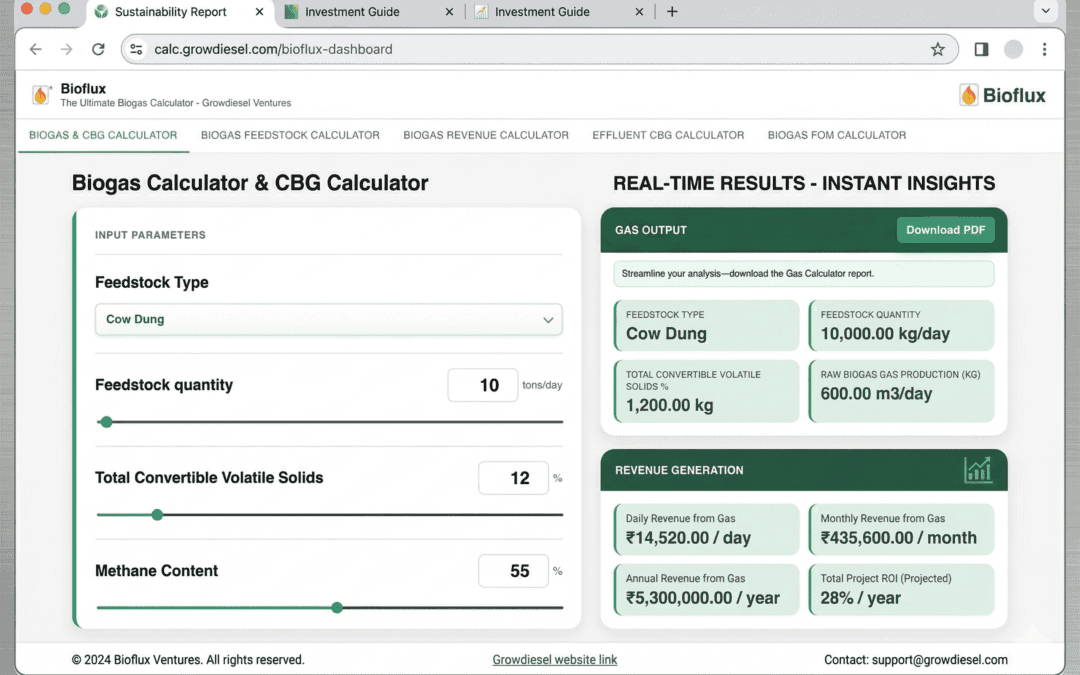
The Indian biofuel landscape has shifted dramatically in 2026. With the Compressed Biogas Obligation (CBO) now requiring a 1% mandatory blending (rising to 5% by 2029), the question for entrepreneurs is no longer “Should I invest?” but “How much will I earn?”
To help you navigate this, Growdiesel has launched an updated Bio-CNG & Feedstock Calculator. Here is how to use it to plan a bankable green energy project.
1. Why Accuracy Matters in 2026
Bio-CNG project success depends on three variables: Feedstock quality, Methane yield, and By-product monetization. A slight error in calculating your Volatile Solids (VS) can result in a 10% revenue gap. Our new tool uses real-time 2026 data to ensure your projections align with current market rates (₹46–55 per kg for CBG).
2. Calculating Your ROI (Step-by-Step)
Using the Growdiesel Calculator, you can model your plant’s performance in seconds:
- Step 1: Input Your Feedstock: Select from Cow Dung, Napier Grass, Sugar Cane Press Mud, or MSW (Municipal Solid Waste).
- Step 2: Define Capacity: Enter your daily tonnage (Tons/Day).
- Step 3: Analyze Methane Content: Our calculator automatically estimates methane (55%–60% for raw biogas) and its refined Bio-CNG (98%+ methane) output.
- Step 4: Revenue & Subsidy Check: Factor in the current ₹4 crore to ₹10 crore capital subsidy available under MNRE schemes for 2026 projects.
3. New Feature: Download Your Custom ROI Report (PDF)
We’ve added a high-value feature to help your bank loan applications and investor pitches. Once you’ve calculated your figures, you can now Download a Detailed ROI PDF Report. This report includes:
- CAPEX/OPEX Breakdown: Estimated investment vs. daily running costs
- Revenue Streams: Profit from both Bio-CNG sales and Fermented Organic Manure (FOM).
- Payback Period: Clear timeline for when your project will reach break-even (typically 3–5 years).