
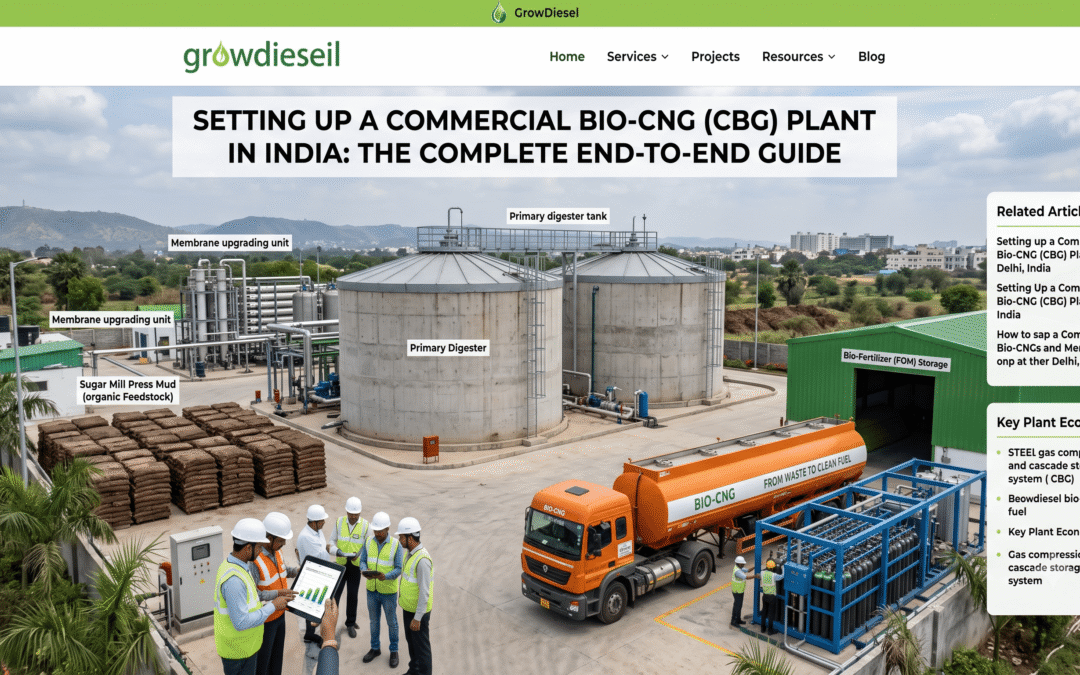
India’s Compressed Biogas (CBG) sector has officially entered its commercial scale-up phase.
Backed by the Union Cabinet’s ₹23,731 crore unified GOBARdhan framework, the policy ecosystem now offers assured offtake, stable pricing mechanisms, and dedicated pipeline infrastructure support. Yet, across the industry, a critical divide is emerging: while some Bio-CNG plants are achieving rapid capital payback, others struggle with under-utilization and squeezed margins.
The difference comes down to a single shift: moving from subsidy-led planning to operational and biological efficiency.
1. The Policy Tailwinds Are Locked In—Execution Is Now the Differentiator
For years, early CBG entrepreneurs worried about off-take certainty and fluctuating gas prices. Today, the regulatory floor is firm:
-
Guaranteed Market Pull: CGD entities must meet statutory blending targets in both CNG (Transport) and PNG (Domestic) segments.
-
Infrastructure & Credit Backing: The GOBARdhan rollout directly addresses historical bottlenecks like cascade transport costs and grid connectivity through cluster-based pipeline support and credit guarantees.
Because administered pricing and off-take frameworks are already established, incremental profitability now depends on what happens inside the plant gates—specifically, how consistently a facility converts raw organic waste into pipeline-grade methane.
2. Three Operational Bottlenecks Eroding Bio-CNG Margins
Even with strong off-take agreements, CBG plants frequently lose 20% to 35% of their projected revenue due to three preventable issues:
A. Digester Instability & Feedstock Variability
Relying on a single seasonal crop residue (like paddy straw) leads to feedstock shortages and volatile digester biology. Switching abruptly between press mud, municipal organic waste, cattle dung, and Napier grass without stabilizing the microbial environment causes foaming, pH drops, and sharp dips in daily gas yield.
B. Sub-Optimal Methane Purity During Upgrading
To meet IS 16087:2016 standards and CGD injection norms, raw biogas must be stripped of $CO_2$, $H_2S$, and moisture. Inefficient scrubbing systems either consume excessive parasitic power or fail to consistently hit the 96%+ to 98%+ methane purity threshold required to avoid batch rejections.
C. High Evacuation & Compression Costs
Standalone plants located far from trunk pipelines often bleed margins on high-pressure cascade transport. Without localized off-take integration or modular evacuation planning, logistics costs quietly eat into net operating profit.
3. How GrowDiesel Engineers High-Yield, Bankable CBG Projects
At GrowDiesel, our approach is built on the 3Ps of Circular Sustainability—People, Planet, and Profit.
| Operational Challenge | GrowDiesel Engineering Solution | Commercial Impact |
| Slow fermentation & feedstock shocks | Meth-ChemX™ Advanced Organic Waste Fermentation | Stabilizes microbial activity across complex feedstocks (press mud, food waste, agri-residue), unlocking a 20–30% boost in biogas yield. |
| Gas impurity & grid rejection risks | Regwel Industrial-Grade Bio-CNG Upgrading | Delivers 96% to 98%+ pure methane compliant with IS 16087:2016 alongside nutrient-rich Fermented Organic Manure (FOM). |
| Last-mile fuel & fleet economics | G.E.T.S. (GrowDiesel Electric Transportation System) | Bridges Bio-CNG generation with 24×7 clean transport and charging infrastructure, eliminating grid-dependency bottlenecks. |
4. Model Your Plant’s Real-World Unit Economics Before Breaking Ground
Before finalizing land, feedstock contracts, or digester capacity, project developers and investors need granular visibility into CAPEX, feedstock logistics, gas upgrading efficiency, and payback timelines.
Ready to test your project numbers?
Run your feedstock volume, methane yield, and local tariff assumptions through our BiogasFlux ROI & Carbon Impact Calculator to model daily CBG output, organic manure revenue, and capital payback in minutes.
Planning a new CBG facility or upgrading an existing biogas plant?
Connect with GrowDiesel’s technical and project engineering team at [email protected] to schedule a feasibility consultation.