
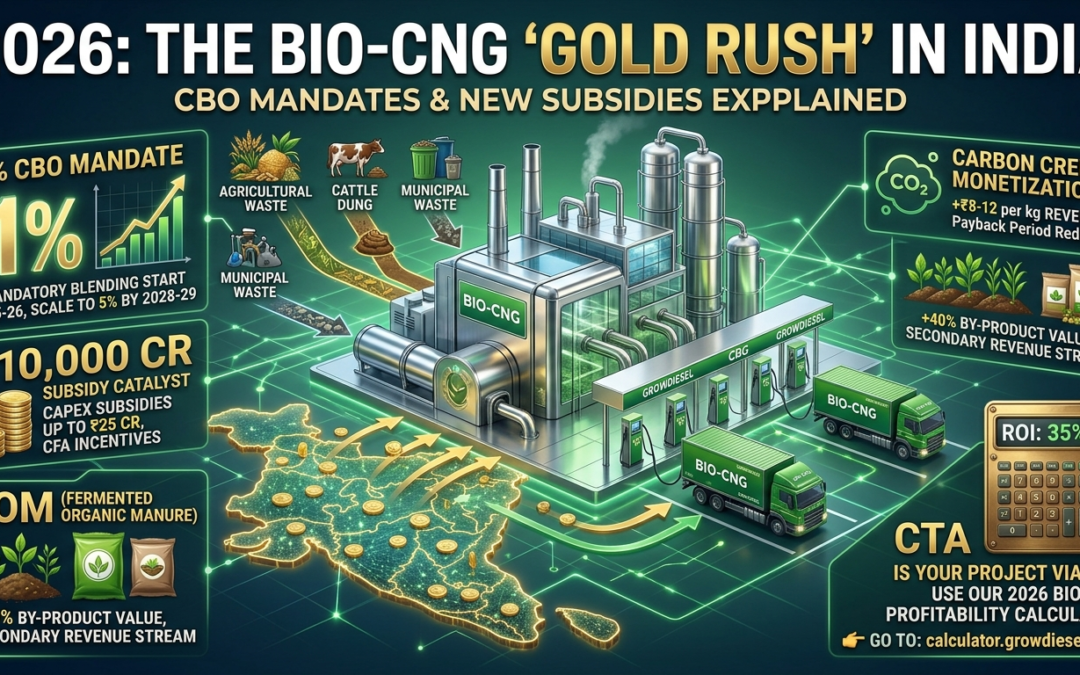
The Indian biofuel landscape has shifted from “incentivized” to “mandatory.” As of April 2026, the Bio-CNG sector is entering its most profitable phase yet. Here is why investors and plant operators are calling this the “Gold Rush” year.
1. The Legal Catalyst: 1% Mandatory Blending (CBO)
The Compressed Biogas Obligation (CBO) is no longer a recommendation—it is a legal requirement. Starting this fiscal year (2025–26), City Gas Distribution (CGD) companies are mandated to blend 1% Bio-CNG into their supply.
-
The Growth Curve: This mandate is set to scale to 3% in 2026-27 and 5% by 2028-29.
-
Guaranteed Offtake: For producers, this eliminates market risk. Oil Marketing Companies (OMCs) are now legally obligated to purchase your output to meet these quotas.
2. Beyond Gas: The “Fermented Organic Manure” (FOM) Revolution
One of the biggest profit drivers in 2026 is the mandatory blending of Fermented Organic Manure (FOM) with chemical fertilizers.
-
Secondary Revenue: You are no longer just a gas plant; you are a fertilizer manufacturer.
-
Market Demand: With the government pushing for organic farming, the demand for FOM has increased the “by-product” value by nearly 40% compared to 2024 levels.
3. Carbon Credit Monetisation
In 2026, the Indian Carbon Market (ICM) will have matured. Bio-CNG plants can now claim Carbon Credits for every tonne of CO2 displaced.
-
Added Revenue: This can add an estimated ₹8 – ₹12 per kg to your total revenue, significantly shortening your Payback Period.
🚀 Check Your 2026 Profitability Potential
With changing feedstock prices and new subsidy slabs, your 2025 calculations are likely outdated. Use our specialized tool to get a real-time financial breakdown.